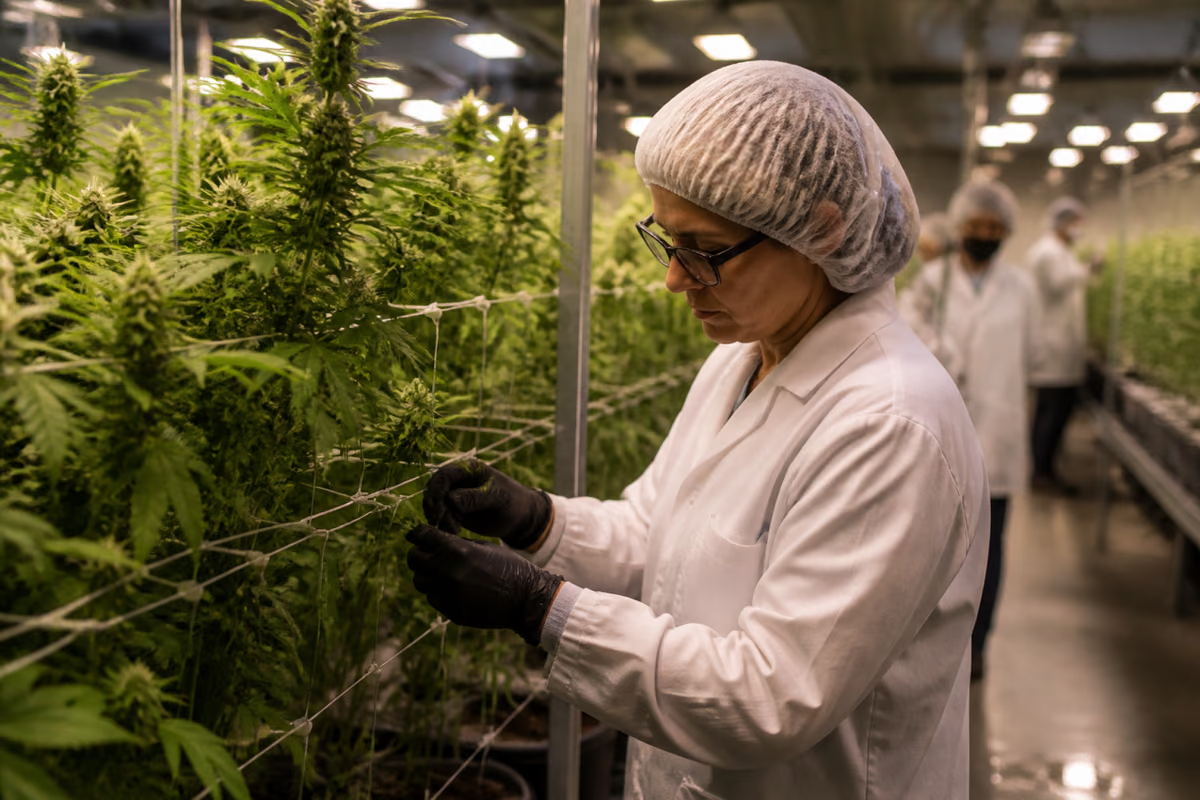
A number that should stop you mid-scroll
More than 1,000 medicinal cannabis products are currently available to patients. Exactly two of them have been formally evaluated by the national drugs regulator for safety, quality and efficacy.
Two, out of more than a thousand.
That figure, reported in recent investigative journalism, says most of what you need to know about the legal cannabis industry in 2024–2025. It is big, it is growing fast, it makes serious money, and it runs almost entirely on regulatory pathways that were built as exceptions rather than as the default.
We're a seed bank, not a pharmacy. This story still matters to us, and it should matter to you, because it exposes the problem that shaped how we built Shottas®Seeds: an industry that scaled faster than its own accountability. When the alternative looks like this, transparency stops being a slogan and starts being the job.
What "evaluated by the regulator" actually means
There is a big difference between a product being legally available and a product being approved.
When a medicine goes through full regulatory evaluation, a national body such as the Therapeutic Goods Administration (TGA) in Australia or the Medicines and Healthcare products Regulatory Agency (MHRA) in the UK reviews a dossier that typically includes:
- Randomised controlled clinical trial data proving the product does what it claims
- Full pharmacokinetic and toxicology profiles
- Manufacturing consistency data, batch after batch after batch
- Stability testing across shelf life and storage conditions
- Documented adverse-event monitoring and risk management plans
Pass all of that, and the product gets registered. In Australia, that means a listing on the Australian Register of Therapeutic Goods (ARTG). Globally, only a handful of cannabis-derived medicines have ever cleared that bar, most notably nabiximols (an oromucosal spray standardised for THC and CBD) and a purified cannabidiol solution used for rare, treatment-resistant epilepsies.
Everything else, meaning the flower, the oils, the vape cartridges, the capsules and the tinctures, sits in a different category. These are "unapproved" therapeutic goods: legal to prescribe, legal to dispense, never evaluated.
How a thousand unapproved products reach patients
The mechanism is straightforward, and on paper it's a good one. Regulators built special access pathways so that patients with serious conditions could get medicines that hadn't yet finished the full approval marathon. Compassionate access, a safety valve.
In practice, three routes do the heavy lifting. Under special access schemes, a doctor applies case by case for a named patient. Authorised prescriber schemes let an approved clinician prescribe to a whole class of patients without applying each time. Clinical trial supply is a much smaller stream.
The valve is now the mains. Regulators have issued hundreds of thousands of approvals in Australia alone since 2016, cannabis clinics operate at scale, and telehealth consultations have turned a bespoke process into a volume business.
Manufacturers still have to meet Good Manufacturing Practice standards and a therapeutic goods order covering contaminants and cannabinoid content. That counts for something. But GMP tells you a product was made cleanly and consistently to a stated specification. It does not tell you the product works, at what dose, for which condition, or how it compares to the twelve near-identical products next to it on the shelf.
Why so few cannabis medicines make it through
It's tempting to blame regulators for foot-dragging. The reality is more complicated, and more interesting for anyone who understands the plant.
1. Cannabis is not a single molecule
Conventional pharma is built around isolating one active compound and characterising it exhaustively. Cannabis flower contains over a hundred cannabinoids, several hundred terpenes and flavonoids, and a chemistry that shifts with cultivar, phenotype, growing conditions, harvest timing and cure. Standardising that into a reproducible pharmaceutical product is hard. It's also why so many patients report that two products with identical THC/CBD percentages feel completely different: the terpene profile is doing work the label never mentions.
2. Full trials are brutally expensive
Taking a medicine through phase III trials costs tens to hundreds of millions. When special access pathways already let you sell at commercial volume without that investment, the business case for registration collapses. Why spend a fortune proving what you can already legally sell?
3. Intellectual property is thin
You can't patent a plant that humans have cultivated for millennia. Without strong IP protection, the return on a nine-figure trial programme evaporates the moment a competitor copies your cultivar.
4. Product churn is relentless
New cultivars, new formats and new formulations hit the market constantly. Regulatory evaluation is measured in years. The product you registered may be commercially obsolete before the paperwork clears.
The real-world consequences for patients
None of this means unapproved products are dangerous by default. Plenty are well made by serious operators. But the absence of independent evaluation creates measurable problems.
Label accuracy varies. Multiple independent analyses across different jurisdictions have found discrepancies between stated and actual cannabinoid content in commercial cannabis products, sometimes well outside acceptable tolerance. If your dose is guesswork, so is your outcome.
Comparison is nearly impossible. With a thousand-plus SKUs, patients and prescribers face a wall of brand names, strain names and percentages with no standardised framework for comparing them. Two products called the same thing may share nothing but marketing.
Evidence stays thin. Because most supply flows outside trials, the industry generates enormous sales data and comparatively little clinical evidence. The knowledge gap persists because the commercial model doesn't require closing it.
Safety signals get missed. Adverse event reporting for unapproved goods is patchier than for registered medicines, and regulators have flagged this repeatedly.
The same lesson, one industry over: what this means for seeds
The medicinal market's transparency gap is the mirror image of a problem that has dogged the cannabis seeds market for decades: a market flooded with product, names that mean whatever the seller wants them to mean, genetics sold on hype rather than data, and buyers with no reliable way to compare option A against option B.
The cannabis seed industry has its own version of the "1,000 products, two evaluated" problem. Anyone can put a famous strain name on a packet. There is no global registry of cannabis cultivars, no independent body verifying that the "Gelato" you bought is genetically related to the original cut, and no standard for how flowering time, yield potential or cannabinoid range should be reported. Buyers are left to trust reputation and reviews.
We built Shottas®Seeds around the opposite instinct. Built by growers for growers means we publish what we know: the parent genetics, the realistic flowering window, the expected structure, the aroma and flavour profile as we experienced it, and the honest yield range rather than a fantasy number. Average is our enemy, and so is vagueness.
Genetics are the first quality control step
Every conversation about product consistency in cannabis eventually arrives at the plant. Before extraction, before GMP facilities, before packaging, there's a seed and a genotype.
Stable, well-worked genetics produce uniform plants, and uniform plants produce predictable chemistry, which is the foundation of any product a regulator could ever evaluate. Unstable, poorly selected genetics produce a field of phenotypes with wildly divergent cannabinoid and terpene expression, and no amount of downstream processing fully fixes that.
This is why feminized seeds matter beyond convenience. Taking males out of the equation eliminates pollination risk and removes a major source of variability across a crop. Every plant flowers, and every plant contributes to a consistent harvest profile rather than a lottery.
It's also why autoflowering seeds have become a serious tool rather than a beginner's shortcut. The good modern autoflowers carry ruderalis-derived day-neutral flowering with potency and terpene profiles that hold up against photoperiod varieties. Their fixed life cycle means the timeline is predictable to within days. For anyone chasing repeatable results across multiple runs, that predictability is a form of quality control in itself.
What better transparency would actually look like
Whether we're talking about medicinal products or a packet of seeds, the fixes are not exotic:
- Independent verification: third-party testing, published, with batch numbers that mean something.
- Standardised descriptors: full cannabinoid and terpene profiles, not just a THC headline, and chemovar classification instead of strain-name folklore.
- Honest ranges rather than best-case numbers, with yields and potencies expressed as realistic bands and the conditions that produce them.
- Traceable lineage: where the genetics came from, and who worked them.
- Post-market data collection: structured feedback from real patients and real growers, fed back into product development.
Regulators are beginning to move. There is growing pressure to tighten advertising rules for cannabis clinics, to strengthen prescribing oversight, and to require more rigorous post-market surveillance of unapproved products. Some jurisdictions are exploring intermediate registration pathways that would sit between full pharmaceutical approval and the current free-for-all.
None of that will produce a thousand approved medicines overnight. But it might make the gap between "available" and "evaluated" a little less absurd.
Where growers fit into all this
For people in jurisdictions where home cultivation is legal, this story adds fuel to an argument that's been building for years: growing your own gives you visibility that no supply chain can match. You choose the genetics, control the inputs, and know exactly when the crop was harvested and how it was cured. Nothing is hidden between the plant and you.
That's not a claim about medicine. We're a seed bank, not clinicians, and nothing here is medical advice. It's a claim about knowledge. The under-discussed feature of home cultivation is informational: you are the only person in the chain, so there's no one left to obscure anything.
What you do need is genetics you can trust to behave as described, and that's the part we take seriously: clear cataloguing, honest comparisons between varieties, and real descriptions of aroma, flavour and effect rather than recycled copy. Add discreet international shipping, free seeds with every order, and a catalogue that mixes proprietary Shottas genetics with classics we've reworked properly rather than renamed. No mediocre.
A thousand products, two evaluated. That's the industry's problem to fix. Ours is simpler: tell you exactly what's in the packet, and make sure it grows into what we said it would.
Frequently asked questions
What does it mean that only two medicinal cannabis products have been evaluated by the regulator?
It means only two products have completed full regulatory assessment, the process that reviews clinical trial data, manufacturing consistency, stability and safety, and ends in formal registration. The other 1,000-plus products are supplied legally through special access and authorised prescriber pathways as "unapproved therapeutic goods." They must meet manufacturing and contaminant standards, but the regulator has never independently assessed their efficacy or clinical performance.
Are unapproved medicinal cannabis products unsafe?
Not necessarily. Most are produced under Good Manufacturing Practice and must comply with orders governing contaminants and cannabinoid content. The concern is not that they are inherently dangerous, but that no independent evidence base confirms what they do, at what dose and for which conditions, and that independent testing has shown label accuracy varying between products and batches.
Why don't more cannabis companies get their products approved?
Three main reasons: full clinical trial programmes cost tens to hundreds of millions; cannabis genetics are difficult to patent, so the commercial return on that investment is weak; and special access pathways already permit sales at commercial scale without registration. Under the current framework there is very little financial incentive to pursue full approval.
How does any of this connect to cannabis seeds?
Both markets suffer from the same underlying issue: enormous product volume with minimal standardised, verifiable information. There is no global cultivar registry, no universal standard for reporting flowering times or cannabinoid ranges, and strain names are often marketing rather than genetics. Product consistency in cannabis always starts at the genetic level, which is why transparent cataloguing and stable, well-worked genetics matter as much in a seed bank as they do in a pharmaceutical facility.
Do feminized and autoflowering seeds improve consistency?
They help significantly. Feminized seeds remove males from the equation, eliminating pollination risk and reducing variability across a crop so that every plant contributes to a uniform harvest profile. Autoflowering seeds add a fixed, day-neutral life cycle, making timelines highly predictable across repeat runs. Neither replaces careful phenotype selection and stable breeding work, but both reduce the number of variables between planting and harvest.
Is home growing a legitimate response to this transparency gap?
In jurisdictions where cultivation is legal, home growing gives you complete visibility over genetics, inputs, harvest timing and curing. That's an informational advantage no commercial supply chain can match. It is not a substitute for medical care or professional advice, and cultivation laws vary enormously, so always check what applies where you live before germinating anything.





 Europe