From green rush to regulation: Thailand rewrites its cannabis story
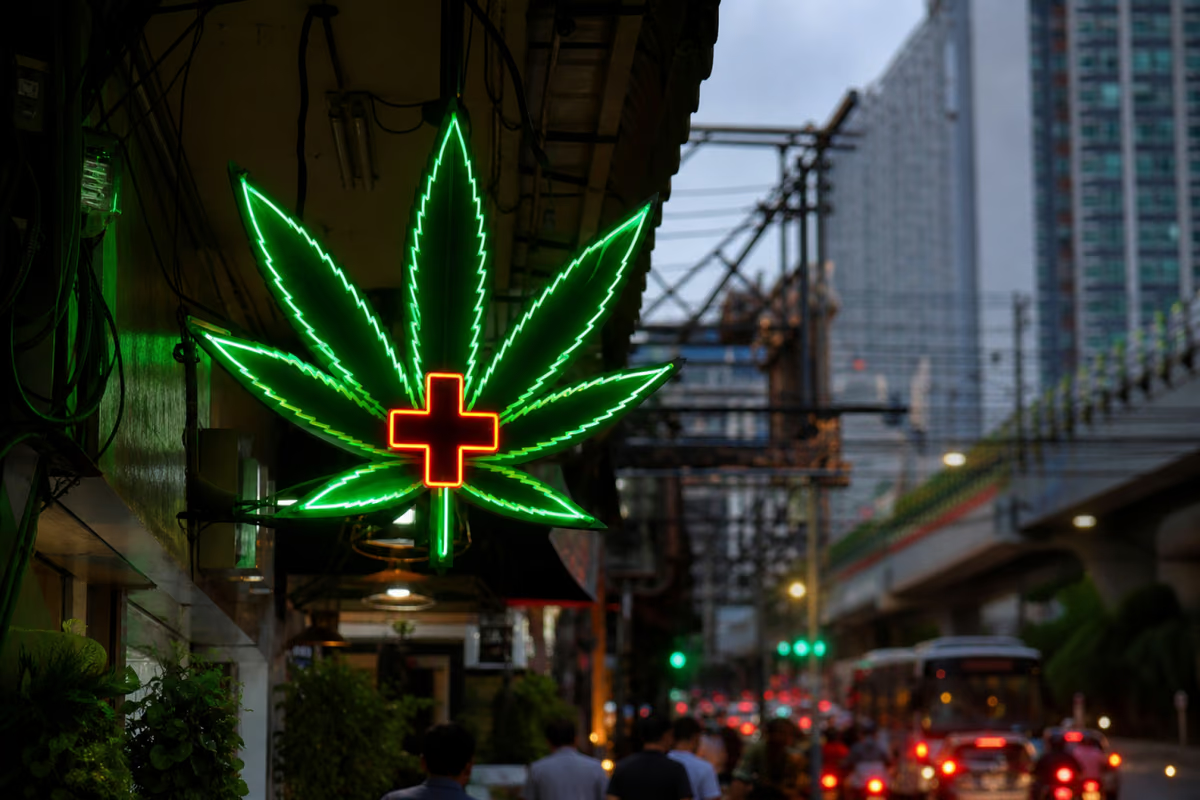
In June 2022 Thailand pulled cannabis off its narcotics list, the first country in Asia to do it. Licences went out, and an industry appeared almost overnight. Bangkok's Sukhumvit Road turned neon green. Chiang Mai, Phuket and Pattaya filled up with dispensaries, sometimes three to a block.
Now the handbrake is on.
According to reporting carried by China Daily Asia and other regional outlets, Thai authorities are steering the country's cannabis retail sector toward medical use only, and the number of operating shops is falling fast. The most permissive cannabis market in Asia is being rebuilt into something closer to a prescription system. If you grow, buy seeds, or follow the global market, the detail here matters more than the headline does.
How Thailand got here
In June 2022, Thailand removed cannabis from its Category 5 narcotics schedule. The stated goal was medical and economic: support farmers, build a wellness industry, attract investment. But no comprehensive cannabis act was ever passed to fill the legal vacuum, so recreational sales flourished in the grey zone that followed.
Growth was fast. Tens of thousands of licences were issued across cultivation, processing and retail. Estimates of dispensary numbers ranged from roughly 11,000 to over 18,000 at the peak, depending on which licence category you counted. Tourists flew in specifically for it. Local entrepreneurs mortgaged property to open shops.
Then came the correction:
- In June 2025, Thailand's Ministry of Public Health reclassified cannabis flower as a controlled herb, so retail sale now requires a prescription from a licensed practitioner.
- Through mid-to-late 2025, enforcement tightened. Shops faced stricter record-keeping, prescription documentation and inspections, and licence renewals became harder to obtain.
- By late 2025, officials had signalled a further move to restrict cannabis to medical channels, with continued discussion around relisting it as a narcotic with medical exemptions.
The commercial fallout was immediate. Reports indicate thousands of retail outlets have closed or surrendered licences, and the surviving businesses are restructuring around clinics, licensed practitioners and documented patient sales. The walk-in, buy-a-gram, walk-out model is on its way out.
Why Thailand changed course
Calling this a crackdown misses what happened: it corrects a policy that was never fully built in the first place.
The regulatory gap
Decriminalisation happened without a governing cannabis act. Licensing authorities improvised, enforcement bodies were uncertain, and businesses operated under rules that could change with a ministerial announcement. No industry thrives on that kind of foundation.
Youth access and public health concerns
Thai health officials repeatedly cited concerns about underage access and unregulated consumption. Without age verification applied consistently across thousands of outlets, the political pressure built quickly.
Tourism optics
Thailand's tourism sector is enormous and sensitive about its image. As cannabis retail became more visible, so did the debate about whether it was attracting the wrong kind of visitor. Neighbouring countries with severe cannabis penalties also applied diplomatic pressure over cross-border trafficking.
Market saturation
Even without the policy shift, the market was overheating. Too many shops, too much low-grade product, margins collapsing. Regulation sped up a shakeout the economics had already started.
What this means for cultivators
Thailand's household cultivation framework, the registration system that let individuals grow plants at home after notifying authorities, has been part of the conversation throughout. The direction of travel suggests home growing will continue to exist, but inside a more clearly defined medical and personal-use framework rather than as a feeder for commercial retail.
For growers elsewhere, the lesson goes beyond one country's rulebook. Markets that open fast tend to flood with volume. Markets that mature tend to reward quality, and quality starts with genetics.
That is why we keep saying the seed decides more than the light or the nutrients do. When a market shifts toward medical standards, cultivators get asked harder questions. What's the cannabinoid profile? What's the terpene expression? Is the phenotype stable batch to batch? Can you document it?
Cheap, anonymous cannabis seeds can't answer any of that. Properly bred, properly catalogued genetics can.
Medical markets run on consistency, and consistency comes from breeding
A recreational grey market tolerates variability. A medical framework does not. Patients and practitioners need predictable outcomes, which means growers need predictable plants.
Feminized seeds
Feminized seeds remove the male variable. In a photoperiod grow, that means no weeks spent raising plants you will cull, no pollination accidents wrecking a crop, and no guesswork in a space-limited setup. Where every square metre and every regulated plant counts, as it does under legal plant limits, running feminized genetics is efficient. If you're allowed six plants, you want six flowering plants, not four and two surprises.
Autoflowering seeds
Autoflowering seeds bring ruderalis heritage into the mix and flip to flower on age rather than light cycle. Harvests come faster, plants stay smaller, and you can fit several runs into a short weather window, or keep the whole thing discreet. In tropical conditions like Thailand's, where day length barely changes across the year and photoperiod plants can behave unpredictably outdoors, autos are a practical alternative: plant, wait, harvest, then start again.
Modern autos are nothing like the thin, low-potency versions that gave the category a bad name a decade ago. Breeding has closed most of the gap on potency, yield and terpene depth.
What other markets went through first
Every maturing cannabis market has been through some version of Thailand's experience. Canada saw a licensed-producer shakeout. Several US states watched dispensary counts contract after issuing too many permits early on. Spain's club scene has cycled through waves of tightening and loosening. The pattern repeats: rapid expansion, oversupply, regulatory tightening, then consolidation around operators who can prove quality and compliance.
What comes out the other side is serious cultivation, documented genetics, and honesty about what's actually in the plant. Canada, the US and Spain all point the same way. Growers and businesses that treat cannabis as an agricultural and pharmacological discipline outlast the ones treating it as a novelty.
Practical takeaways for growers watching this unfold
- Check your local law before you plant. Rules change, sometimes with weeks of notice. Cannabis seeds are legal to buy and own as collector items in many jurisdictions where cultivation is not, so never assume.
- Prioritise stability over hype. A stable, well-documented strain beats a mystery cut every time, especially if you ever need to explain what you grew.
- Match genetics to your climate and constraints. Hot, humid, unpredictable? Look at mould-resistant, fast-finishing autoflowering seeds. Indoor tent with a tight plant count? Feminized seeds.
- Keep records: germination dates, feeding schedules, harvest weights, phenotype notes. Medical-leaning frameworks reward documentation, and it makes you a better grower anyway.
- Buy from producers who tell you what's in the pack, including lineage, flowering time and expected profile. If a seed bank won't say, ask why.
Where we stand
Thailand's pivot is a growing pain rather than a tragedy for cannabis: a country working out in real time how to regulate something it legalised faster than it legislated. Some businesses won't survive it. The ones that do will likely operate to a higher standard.
For us, the point hasn't moved since day one. Genetics are the non-negotiable. Whatever the legal framework looks like where you are, and whatever the market does next, the difference between a disappointing grow and a great one is decided before you ever switch a light on.
Built by growers, for growers.
Frequently asked questions
What exactly is Thailand changing about its cannabis rules?
Thailand is moving its cannabis retail sector away from open recreational-style sales and toward a medical-use framework. Cannabis flower has been reclassified as a controlled herb requiring a prescription from a licensed practitioner, and enforcement around licensing, documentation and inspections has tightened. Officials have also discussed restricting cannabis further while preserving medical access.
Why are cannabis shop numbers falling so sharply?
Several factors combined. Prescription requirements cut off the walk-in tourist trade that many shops depended on. Licence renewals became harder and compliance costs rose. The market was also already saturated, with thousands of outlets competing on price with oversupplied product. Regulation accelerated a shakeout that market economics had already begun.
Can people still grow cannabis at home in Thailand?
Thailand introduced a household cultivation registration system after 2022, and personal cultivation has remained part of the policy discussion. The framework is being tightened, though, and increasingly tied to medical and personal-use justification rather than commercial supply. Anyone considering cultivation should verify the current requirements directly with Thai authorities, since the situation has changed repeatedly.
How does a medical-focused market affect the type of seeds growers choose?
Medical frameworks demand consistency and documentation. That pushes growers toward stable, well-bred genetics with known cannabinoid and terpene profiles. Feminized seeds maximise usable plants under legal plant-count limits, while autoflowering seeds offer fast, predictable cycles that suit tropical climates and discreet, space-limited setups. Unstable or undocumented genetics don't fit a regulated environment.
Does Thailand's reversal signal that cannabis liberalisation is failing globally?
No. It signals that legalisation without a complete legislative framework creates instability. Mature markets in Canada, the United States and Europe have all been through consolidation phases after rapid expansion. What usually emerges is a smaller, more professional sector focused on quality and compliance rather than volume, which benefits serious cultivators and patients alike.



 Europe