
Central Europe has been rewriting its cannabis rules, and the Czech Republic is one of the places where the change has been clearest. For years Czechia had a reputation as one of the most relaxed countries on the continent: tolerated possession, a working medical programme, and a grow scene that never really went away. But reputation and legislation are two different animals, and in 2024 the gap between them narrowed considerably.
We're growers first, so we care about the practical side: how many plants, what happens at the border, which cannabis seeds actually make sense under a plant-count limit. The questions below are practical ones: what the reform changed, what it left alone, and how that shapes your next run.
Where Czech law stood before the 2024 reform
The Czech Republic never criminalised cannabis the way its neighbours did. Since 2010, possession of a "small amount", commonly interpreted as up to 10 grams of dried flower, has been treated as a misdemeanour rather than a crime, punished with an administrative fine. Growing up to five plants fell into the same category: not legal, but not a criminal offence either.
Medical cannabis arrived in 2013, with pharmacy distribution and, from 2020, substantial insurance reimbursement. Industrial hemp cultivation has been a normal agricultural activity for decades. The result was a curious legal grey zone: a country where nobody was going to prison over a few plants on a balcony, but where nothing about home growing was actually lawful.
Lawmakers set out to fix that ambiguity.
2024: the year the Czech approach changed direction
The original plan was ambitious. Under national drug policy coordinator Jindřich Vobořil, the government drafted a framework for a fully regulated adult-use market: licensed cultivation, licensed retail, taxation, quality control. It would have made Czechia the third EU member state after Malta and Luxembourg to move beyond decriminalisation, and the first to attempt a commercial model comparable to Germany's.
Political reality intervened. Coalition partners balked, the Ministry of the Interior raised objections, and by mid-2024 the comprehensive market bill had been shelved. What survived was narrower: an amendment creating a new legal category of psychomodulatory substances, alongside changes to the Criminal Code covering personal cultivation.
The Chamber of Deputies approved it in late 2024, the Senate followed, and President Petr Pavel signed it. The core provisions took effect on 1 January 2025.
What actually changed
- Home cultivation of up to three plants for personal use is no longer a criminal offence. That is a clear legal threshold, replacing the previous "small amount" interpretation.
- Possession thresholds for personal use went up, with distinct limits for what you carry in public and what you store at home.
- The new regulatory category for psychomodulatory substances brings products like kratom and semi-synthetic cannabinoids under state supervision instead of a blanket ban.
- The technical hemp THC limit rose from 0.3% to 1%, one of the most permissive thresholds in the European Union, with real consequences for the domestic hemp and CBD sector.
What did not change
Czechia did not legalise a recreational market. There are no coffeeshops, no licensed dispensaries for adult use, no cannabis social clubs on the Maltese or German model. Selling, gifting, or distributing cannabis outside the medical system remains a criminal offence, and the penalties for commercial-scale cultivation are serious.
The reform is also purely domestic. It creates no right to import cannabis, and Czech law has no bearing on what happens when you cross a border. Zero tolerance still applies to driving. Employers, landlords, and licensing bodies keep their own rules.
Decriminalised and legal are not the same thing, and it's worth keeping them apart.
Why the three-plant limit changes how you should plan a grow
Under the old five-plant tolerance, growers had room for error. Pop a few extra seeds, cull the weak ones, keep the best. A hard limit of three plants removes that cushion. Every plant occupying a legal slot has to earn it.
Three consequences follow directly:
1. Feminized seeds become the default rather than the preference
Regular seeds produce roughly 50% males. Under a three-plant ceiling, that's a coin flip on your entire season. Feminized seeds remove that gamble: every plant that breaks the soil is a flower producer. If you're working within a legal plant count, feminized genetics are the rational choice, and you don't burn a slot on a plant you'll have to pull at week four.
2. Autoflowers let you multiply harvests without multiplying plants
A plant-count limit restricts how many plants you grow at once, not how many cycles you run in a year, and that's the gap autoflowering seeds fill. Because ruderalis-derived autoflowers switch to bloom on age rather than photoperiod, they complete a full seed-to-harvest cycle in roughly 70–100 days regardless of light schedule.
Run three autos indoors, harvest, reset, repeat. Four cycles a year from three legal plants beats one oversized photoperiod harvest for a lot of growers, and it spreads risk. Lose one crop to pests or a heat wave and you're twelve weeks from recovery, not twelve months. Outdoors in the Czech climate, autos also dodge the September rain that punishes late-finishing photoperiod varieties in continental Europe.
3. Photoperiod plants have to do more work
If you'd rather go the other way — fewer cycles, maximum yield per plant — photoperiod feminized genetics with strong lateral branching reward the effort. Training techniques like topping, LST, mainlining, and ScrOG exist precisely to turn a small number of plants into a large canopy. Under plant-count law, canopy management is the strategy itself rather than a hobbyist flourish.
The legal status of cannabis seeds themselves
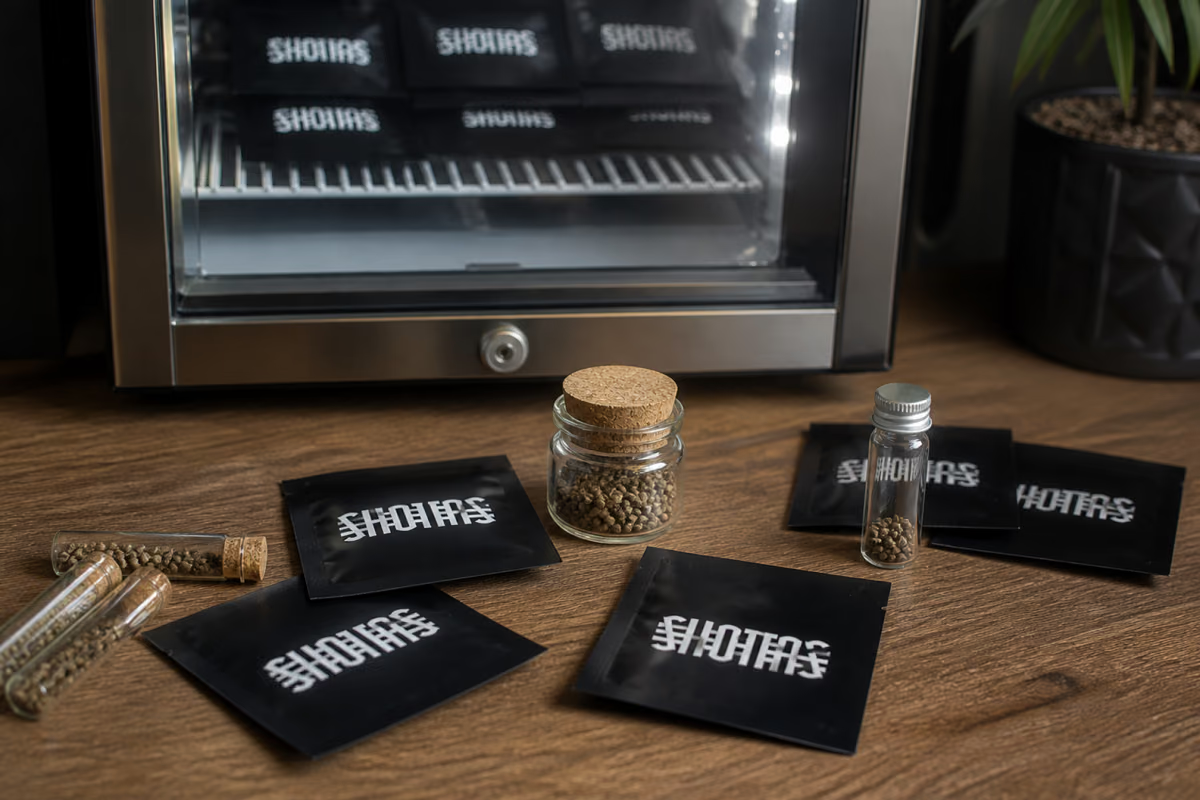
Cannabis seeds contain negligible THC and are treated as a legal commodity across most of the European Union, including the Czech Republic. Buying, owning, and collecting them is not the same act as germinating them. That's why a seed bank can ship internationally while cultivation law varies wildly from country to country: the seed is legal, the plant is regulated.
What you do after the seed arrives is governed by your local law, and that responsibility sits with you. We ship discreetly, we ship internationally, and we expect our customers to know the rules where they live.
Czechia in the wider European picture
The 2024–2025 Czech reform didn't happen in isolation. Germany's Cannabis Act took effect in April 2024, permitting home cultivation of three plants and non-commercial cultivation associations. Malta legalised personal growing in 2021 and licensed its first cannabis associations shortly after. Luxembourg followed with a four-plant household allowance. Switzerland runs regulated pilot trials in several cities.
Home cultivation is consistently the first door European legislators open. It's politically defensible, it avoids treaty complications around commercial supply, and for growers it puts genetics back at the centre of the question. When the state permits three plants, seed quality becomes the biggest variable a grower controls.
What to watch beyond 2024
The regulated market bill hasn't been dropped, only parked. Czech policymakers have repeatedly signalled that a licensed adult-use framework remains on the long-term agenda, and pressure from Germany's model and tax revenue arguments keep it alive in public debate. Elections, coalition arithmetic, and EU-level legal opinions will decide the timeline.
Meanwhile, the 1% THC hemp threshold may end up mattering more than the plant count. It opens space for domestic breeding, CBD-rich cultivars, and agricultural research that most EU countries still can't legally touch.
Build your skills now. Learn your genetics, dial in your environment, understand terpene expression and harvest timing. Legislation moves in fits and starts, while what you learn about your plants stays useful whatever the law does.
FAQ
Is cannabis legal in the Czech Republic in 2024?
Not in the full sense. Personal possession of small amounts has been decriminalised since 2010, and a 2024 amendment effective 1 January 2025 allows home cultivation of up to three plants for personal use without criminal liability. There is no legal recreational retail market, and selling cannabis remains a criminal offence.
How many cannabis plants can I legally grow in Czechia?
Up to three plants for personal use under the amended Criminal Code. Exceeding that threshold moves you back into criminal territory, so plan your grow around the limit rather than testing it.
Which seeds are best under a three-plant limit?
Feminized seeds, without hesitation, because you can't afford to lose a slot to a male. Autoflowering seeds are ideal if you want several harvests per year from the same plant count, while photoperiod feminized varieties combined with training techniques maximise yield per plant.
Can I legally buy cannabis seeds and have them shipped to the Czech Republic?
Cannabis seeds contain negligible THC and are generally treated as a legal commodity in the EU, including Czechia. Purchase and possession of seeds is distinct from cultivation, which is governed by the rules described above. Always verify current local law before germinating.
Did the Czech Republic legalise a commercial cannabis market?
No. The comprehensive regulated-market proposal drafted in 2023–2024 was shelved because of coalition disagreements. What passed was a narrower reform covering home cultivation, possession thresholds, psychomodulatory substances, and a 1% THC limit for technical hemp.




 Europe