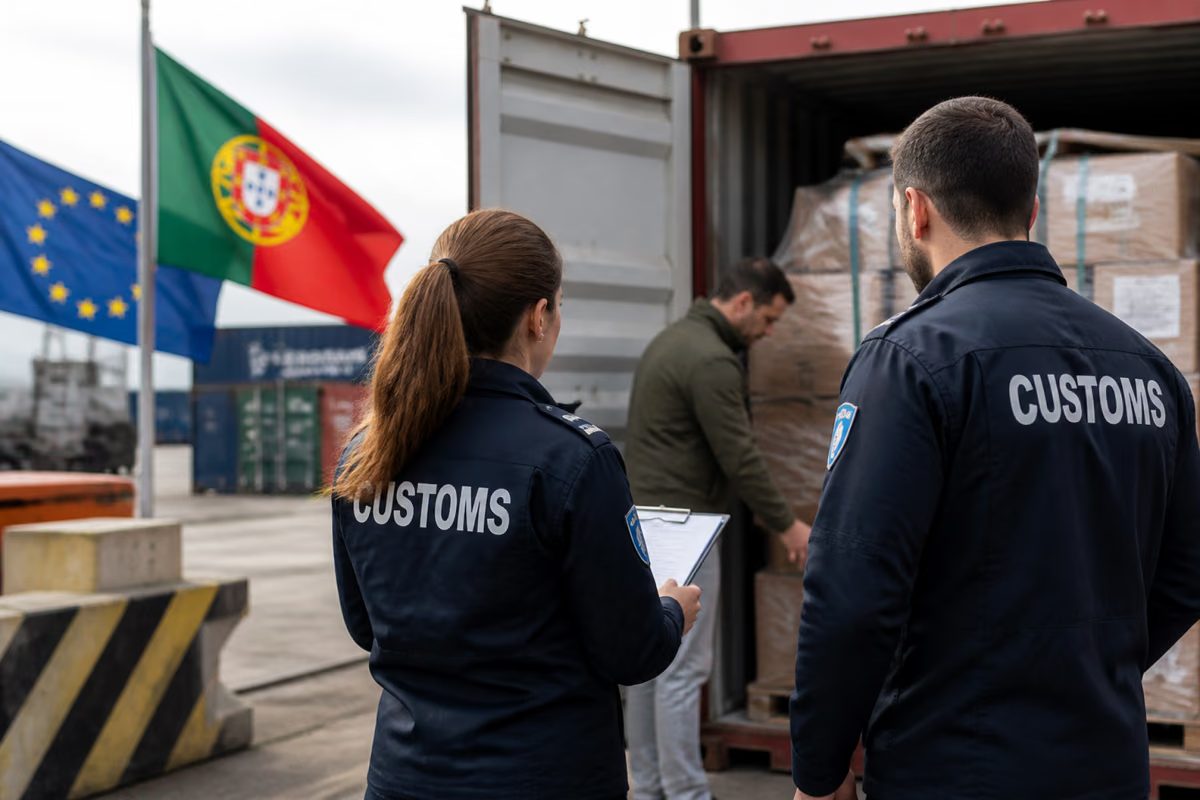
Infarmed, Portugal's National Authority of Medicines and Health Products, says its year-long crackdown on medical cannabis was a response to failures in record-keeping and traceability. It was not a response to problems with the cannabis itself. The regulator also says export certificates now take 12 days to issue. Speaking at the Portugal Medical Cannabis (PTMC) conference in Lisbon on September 10, 2026, Infarmed's licensing chief described the weak points as paperwork and partner checks. The medicines were not the problem. This matters because Portugal's role as Europe's main cannabis gateway now depends on whether operators believe that message and decide to stay.
Portugal's Role as Europe's Medical Cannabis Doorway
Portugal is Europe's largest exporter of medical cannabis. For years it has been described as the "doorway" to European markets. Growers and processors from around the world have routed product through Portuguese facilities because the country combines a favourable climate with an established licensing framework. It also offers EU-recognised quality certification.
That reputation came under pressure during the past year. A criminal investigation exposed weaknesses in how exported product was tracked. Infarmed responded by tightening oversight, and licensing slowed down as a result. Operators faced longer waits for permits and renewals. Some international supply chains began moving to other European processing hubs, which can be faster and carry less reputational risk.
Volumes have not collapsed. Infarmed reports 79,883kg of cannabis exported in 2025, and more than 66,000kg shipped in the first half of 2026 alone. If that pace holds, 2026 will comfortably beat the previous year. The open question is whether that growth survives once pending rerouting decisions take effect. Some operators are still weighing whether to stay in Portugal or move their logistics elsewhere.
Operation Erva Daninha: How Forged Paperwork Moved Tonnes
The crackdown began with a judicial police investigation called "Erva Daninha", Portuguese for "weed". In May 2025 it led the Central Department of Investigation and Prosecution (DCIAP), Portugal's unit for complex and organised crime, to charge 24 defendants. They were 13 individuals and 11 companies. The charges included criminal association, aggravated trafficking, money laundering and document falsification.
According to the indictment, as reported by Observador and Executive Digest, the network forged import certificates. An import certificate is the document a destination country issues to confirm it has authorised a shipment of a controlled substance. The forged papers declared cannabis as bound for the Democratic Republic of Congo, Guinea-Bissau and Kenya. The product was then diverted to European markets.
- An impossible date: one certificate attributed to a Guinean authority carried an expiry date of February 30, 2024. That date does not exist, yet the certificate was still cleared.
- Congo: around 5,533kg was declared for export across 2024 and 2025, but Congo recorded no matching import.
- Kenya: a 357kg consignment in 2025 compared with an approved national import estimate of just 300 grams. An import estimate is the annual quantity a country is officially authorised to import under international drug-control rules.
The court filings indicate that the forged paperwork deceived Infarmed and that the regulator was not complicit. That has done little to quiet criticism from industry or from other authorities.
What Infarmed Has Changed Since the Investigation
Vasco Bettencourt, Director of the Licensing Unit within Infarmed's Inspection and Licensing Directorate, told the conference that supervision has been strengthened in three areas.
- Traceability: the ability to follow every batch from cultivation through processing to its verified final destination.
- Waste management: documented destruction of plant material and rejected product, so that surplus cannot quietly leave the system.
- Qualification of customers and suppliers: due diligence that confirms each trading partner is genuinely licensed and genuinely exists.
A new national reporting platform and a quarterly reporting model were approved in June 2026. Together they are designed to give Infarmed production data it can verify. Since June, the regulator says it has held more than 14 meetings with licensed companies to help them adopt the new requirements.
Inspections have also expanded. Ana Rita Martins is an Infarmed inspector for Good Manufacturing Practice (GMP), the EU quality standard for producing medicines. She said inspections now cover established operators as well as new licence applicants. Industry welcomed the change, but it has slowed licence renewals.
Infarmed stressed that suspension, revocation and non-renewal of licences are "not objectives". They are legal tools for dealing with non-compliance. The regulator also suggested that much of the diverted product would have been caught earlier if traceability had been properly maintained.
Permit Delays: The 12-Day Claim Under Scrutiny
The sharpest exchange of the session concerned export certificate timelines. An export certificate is the authorisation that allows a licensed company to ship controlled cannabis abroad. Delays in issuing these certificates have been the biggest source of frustration for operators since the police operation.
An audience member argued that permits were taking two to three months, compared with about 28 hours in Switzerland. Bettencourt replied that the new platform had cut issuance to 12 days. He added that Infarmed expects to shorten the timeline further.
| Permit benchmark | Reported timeline | Source of claim |
|---|---|---|
| Portugal (operator experience) | Around 2–3 months | Audience member at PTMC |
| Portugal (new platform) | 12 days | Infarmed |
| Switzerland | Around 28 hours | Audience member at PTMC |
Even taken at face value, 12 days is still many times slower than the Swiss benchmark. For exporters on tight delivery contracts, the gap between Infarmed's figure and what operators say they experience will matter more than the headline number.
Exports Keep Climbing Despite Rerouting
The market signals point in different directions. Business of Cannabis reported that Canadian flower exports to Portugal fell 86.6% from their April 2025 peak. Those volumes are now going directly to Germany instead of passing through Portuguese processors. On that measure, part of Portugal's pass-through trade has already gone.
Infarmed's own figures still show total Portuguese export volume rising. German data broadly supports this. Germany is Portugal's largest trading partner, and its regulator, the Federal Institute for Drugs and Medical Devices (BfArM), oversees medical cannabis imports.
| Metric | Figure | Reported by |
|---|---|---|
| Portuguese cannabis exports, 2025 | 79,883kg | Infarmed |
| Portuguese cannabis exports, H1 2026 | 66,000kg+ | Infarmed |
| German imports from Portugal, 2025 | 55.1 tonnes | BfArM |
| German imports from Portugal, Q1 2026 | 10 tonnes | BfArM |
| Portuguese patient prescriptions, 2025 | 7,023 | Infarmed |
| Canadian flower exports to Portugal | Down 86.6% from April 2025 peak | Business of Cannabis |
Taken together, the figures suggest Portugal is losing some intermediary trade while growing its own output. That is a meaningful shift for a country that built its reputation as a hub.
The Transparency Gap: Late Data, Not Wrong Data
The case has also put Infarmed's disclosure process under scrutiny. The question raised was about timeliness, not the accuracy of its numbers. BfArM published its 2025 import records, including 55.1 tonnes from Portugal, while Infarmed's public activity document still covered only up to November 2024.
In early August, the liberal opposition party Iniciativa Liberal questioned the Health Minister about the licensing slowdown and the missing 2025 export and prescription figures. Infarmed published them two weeks later, on August 21. They showed 7,023 patient prescriptions and the 79,883kg export total. The export figure is consistent with Germany's import tally, which suggests the problem was slow publication rather than unreliable data.
Political pressure had been building before that. On June 26, 2026, Secretary of State for Health Ana Povo said "corrective measures" were under way to strengthen the regulator's oversight capacity.
The lesson is that publishing data late can do as much damage to trust as publishing it wrong. When the country importing your product publishes your export figures before you do, people start asking whether anyone is watching.
What This Means for the Wider Cannabis Market
Many established global supply chains still run through Portugal, so exporters will welcome Infarmed's reforms. It remains unclear whether 12-day permits and quarterly reporting will be enough to keep business from moving to faster European hubs with less reputational baggage.
We see a familiar pattern here. Erva Daninha did not expose bad cannabis. It exposed bad paperwork. Fake certificates, partners nobody checked and a date that never existed all got through because traceability was treated as an administrative chore rather than a core discipline. Strong genetics and quality product cannot protect a supply chain whose records fall apart under scrutiny.
That is why we keep returning to transparency as a working principle rather than a slogan. Regulators, processors, breeders and growers all depend on documentation that can stand up to inspection. Portugal is now rebuilding that foundation in public, under political pressure.
Infarmed's message to the Lisbon conference was that the crackdown is meant to be a foundation for the industry, not a barrier. The coming quarters will show whether operators agree, and whether Portugal can stay Europe's cannabis doorway.
Frequently asked questions
Why did Infarmed tighten oversight of Portugal's medical cannabis sector?
Infarmed acted after a criminal investigation found weaknesses in traceability, waste management and checks on customers and suppliers. The regulator says these failures in record-keeping allowed forged documents to be used to divert cannabis. It insists the quality of the cannabis medicines produced in Portugal was never the issue.
What was the Erva Daninha investigation?
Erva Daninha was a Portuguese judicial police operation into cannabis diversion. In May 2025 it led prosecutors to charge 24 defendants, 13 individuals and 11 companies, with trafficking, money laundering, criminal association and document falsification. The network allegedly forged import certificates for African countries and then redirected the cannabis to European markets.
How long does it take to get a cannabis export certificate in Portugal?
Infarmed says its new national reporting platform has cut export certificate issuance to 12 days, and it plans to reduce that further. Some operators say their real waits have been closer to two or three months. Switzerland was cited as a benchmark, issuing comparable permits in around 28 hours.
How much medical cannabis does Portugal export?
According to Infarmed, Portugal exported 79,883kg of cannabis in 2025 and more than 66,000kg in the first half of 2026. German regulator BfArM recorded 55.1 tonnes imported from Portugal in 2025 and another ten tonnes in the first quarter of 2026.
Are cannabis supply chains leaving Portugal?
Some are. Canadian flower exports to Portugal reportedly fell 86.6% from their April 2025 peak as shipments went directly to Germany instead. Even so, Portugal's total export volumes are still rising, which suggests the country is losing some pass-through trade while increasing exports of cannabis it produces domestically.
Was Infarmed's export data inaccurate?
No evidence points to inaccuracy. The criticism concerned delay. Germany published its 2025 import records before Infarmed released its own figures. When Infarmed published its 2025 data on August 21, 2026, the export total matched Germany's import figures. That supports the view that the gap was one of publication timing, not reliability.





 Europe