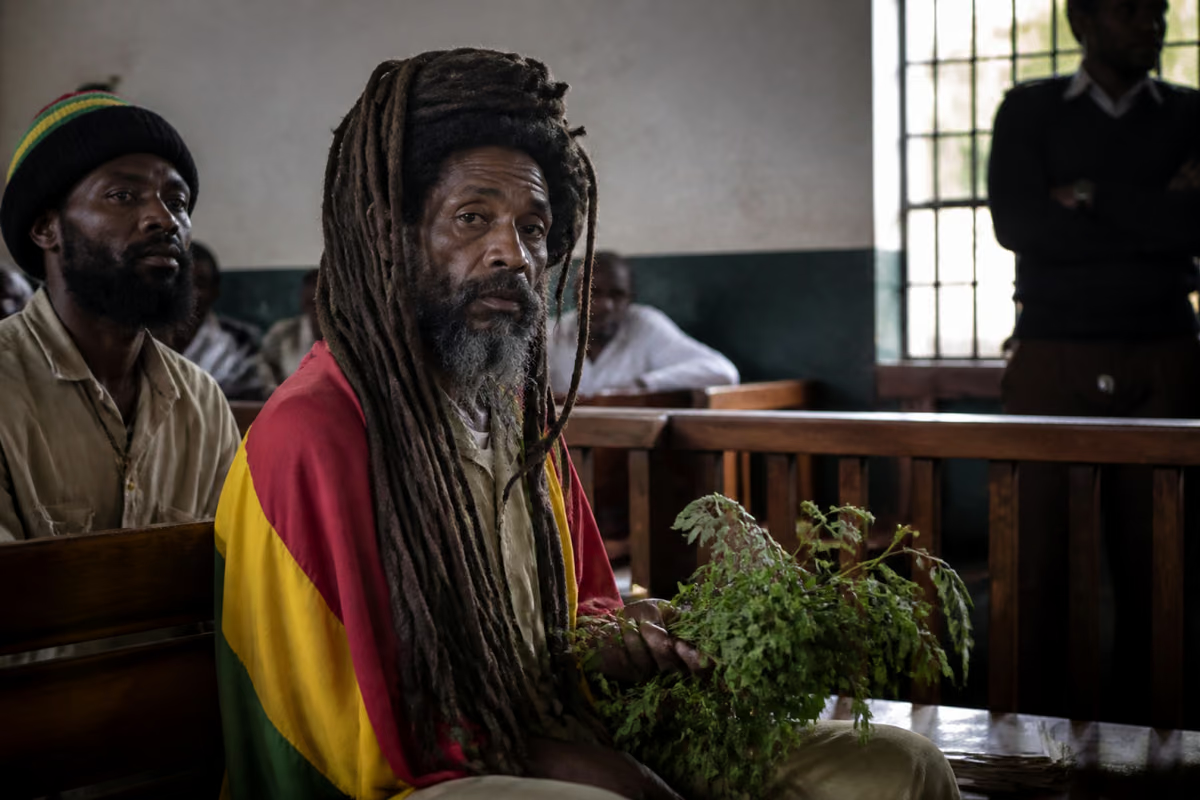
Kenya's Rastafarians want the herb freed because cannabis is a sacrament at the heart of their faith. They argue that criminalising it violates their constitutional rights to freedom of religion and equality. On 15 July 2024, a Kenyan court dismissed their petition to decriminalise spiritual use. The court ruled that the Rastafari Society of Kenya had failed to prove that the law unconstitutionally violated those rights. The society says it will appeal to a higher court. The case matters well beyond Kenya. It tests how far a legally recognised religion can practise its core ritual when that ritual involves a prohibited plant. Rastafari communities around the world are watching closely.
What Is Rastafari?
Rastafari is an Afrocentric religion and social movement. It holds that Haile Selassie I, the former emperor of Ethiopia, is the messiah and God incarnate. Followers call God Jah, a shortened form of the Hebrew name Jehovah. A second central belief is that Black people are oppressed by Babylon, the Rastafari metaphor for western capitalism, imperialism and the systems that grew from colonial rule.
The movement emerged in the 1930s within marginalised Afro-Jamaican communities. Protestant preachers declared that Haile Selassie's coronation fulfilled a biblical prophecy. The faith takes its name from his pre-coronation name, Ras Tafari Makonnen. Ethiopia is often identified with Zion, the promised homeland and spiritual refuge set against Babylon.
Rastafari spread far beyond Jamaica largely through reggae. Bob Marley and the Wailers, Burning Spear and Culture carried its imagery, its language and its message of Black dignity to audiences worldwide. Many Kenyan followers first met the faith through a cassette, a lyric or a concert rather than a sermon. Today the religion has no single central authority. It is organised into several mansions, the term Rastafarians use for their main denominations or orders, each with its own emphasis and rituals.
Why Cannabis Is Sacred in Rastafari
In Rastafari, cannabis is a sacrament. A sacrament is a ritual element or act believed to carry divine grace or to open a direct channel to God. The plant is Cannabis sativa, and followers usually call its dried flower "ganja" or simply "the herb". It is not a party accessory. It is part of worship.
Rastafarians believe that consuming the herb puts them in a meditative state that deepens their connection with the divine. It is commonly shared during communal prayer and chanting. Followers point to biblical passages about "the herb of the field" as scriptural support for its use, and many describe it as a tool for reasoning, reflection and clarity of mind.
This is why prohibition hits the faith so hard. For most religions, drug laws sit far from the altar. For Rastafari, they reach directly into the ritual itself. Followers who cultivate, possess or smoke the herb for worship face the same legal exposure as anyone else. In Kenya, cannabis is controlled under the Narcotic Drugs and Psychotropic Substances (Control) Act of 1994. As a result, many worshippers feel their faith can only be practised by breaking the law. Followers in several countries are now pushing for decriminalisation, the removal of criminal penalties for certain uses, or for specific religious exemptions.
Inside a Nyabinghi Groundation in Kibera
Three days after the ruling, about a dozen members of the House of Nyabinghi gathered in a dimly lit room in Kibera, Nairobi's sprawling informal settlement. Nyabinghi is one of the main mansions of Rastafari. It is named after and inspired by a legendary East African woman whose name means "mother of abundance" or "she who possesses many things". The gathering was a groundation, the Rastafari term for a communal worship meeting of drumming, chanting and prayer. This group holds one every week.
For more than an hour, drums and a tambourine drove song after song. The lyrics were full of references to Ethiopia, Jah, Zion and Haile Selassie I:
"No night in a Zion, there is no night there / Hallelujah there is no night there / Rastafari is our light, and we need no other light / Hallelujah there is no night there."
A red, yellow and green flag hung on the wall beside images of Haile Selassie I, Bob Marley and Marcus Garvey, the Jamaican political activist whose Pan-African vision shaped the movement. Between verses, sizzles and crackles broke through the rhythm as some worshippers lit the herb. Its earthy, resinous scent filled the room. This was not rebellion staged for an audience. It was an ordinary week of worship, carried on under a law that treats a core part of it as a crime.
Four Paths to Rastafari in Kenya
The number of Rastafarians in Kenya is unknown. Like many followers, the worshippers in Kibera were born into Christian families and converted later in life. Converts adopt the title Ras, meaning "head" or "chief" in Amharic, Ethiopia's most widely spoken language. The table below compares four members of the Kibera community.
| Follower | Age | Role | Path to Rastafari |
|---|---|---|---|
| Ras Orudi | 38 | Herbalist | Inspired in secondary school in the mid-2000s by reggae artists such as Peter Tosh |
| Ras Ndeto | 56 | Prophet; spokesperson, Rastafari Society of Kenya | Taught livity in the early 1990s by a Rastafarian from Guyana in Nairobi |
| Ras Dimo | 43 | Priest who often leads prayers | Read books on Black people and the Bible just before finishing secondary school |
| Ras Masinde | 50 | Community member | Fascinated as a child by a man with dreadlocks; began growing his own after school in the 1990s |
Ras Ndeto's teacher introduced him to livity, the Rastafari practice of righteous and natural living. It centres on growing dreadlocks and following an ital diet. Ital food is plant-based, natural and minimally processed, and the word derives from "vital". Dimo put his own awakening plainly: "I was inspired to know that Black people are not cursed as imperialists tried to make us think."
The Petition and the 15 July Ruling
In 2021, the Rastafari Society of Kenya filed a court petition with two alternative requests:
- Exempt Rastafarians from arrest and prosecution for cultivating, possessing and using cannabis as a sacrament, or
- Require the government to create a legal framework that regulates sacramental use.
The society argued that the existing law violated several constitutional freedoms, including freedom of religion and the right to equality. Its reasoning was simple. If the state recognises Rastafari as a religion, it cannot criminalise the faith's central sacrament without justification.
On 15 July 2024, the court dismissed the petition. Among its reasons, it found that the society had failed to prove that the law unconstitutionally violated Rastafarians' rights. For followers, the ruling means nothing changes in the short term. Sacramental use remains exposed to criminal prosecution.
Ras Ndeto said the decision marginalised believers and confirmed that the society would appeal to a higher court. "We still feel that we are a minority group in this country, because even our culture is still looked down upon," he said. His next words carried the weight of daily experience: "We are living like terrorists in our own country."
Recognised Faith, Criminalised Sacrament
Kenyan law has already protected Rastafari once. In 2019, a court recognised Rastafari as a legally protected religion in a landmark ruling. The case began when a schoolgirl said she faced discrimination after her school expelled her for wearing dreadlocks. That ruling protected an outward sign of the faith, the hair grown as part of livity.
The 2024 decision creates a sharp contrast. A Rastafarian in Kenya may now wear dreadlocks without fear of discrimination, yet can still be arrested for the sacrament used in worship. Believers see this as recognition on paper, but not in practice.
Followers are careful to frame their demand as integration, not defiance. "Rastafarians are not rejecting the system," Ras Orudi said. "They are trying to integrate into the system while defending their rights." Ras Masinde tied the struggle to a wider message of cultural return. "We as Rastafarians are urging Black people to go back to their roots and culture," he said. "We fyah bun colonialism and imperialism." Fyah bun literally means "fire burn", and Rastafarians use it to denounce or condemn. Masinde also stressed that every man, woman and child is equal before the eyes of the Almighty.
How Other Countries Handle Sacramental Cannabis
Kenya's Rastafarians are part of a global movement seeking legal space for sacramental cannabis. Governments have taken very different routes:
- Kenya: Rastafari is legally recognised as a religion since 2019, but sacramental cannabis remains criminalised after the 2024 ruling. An appeal is planned.
- Antigua and Barbuda: In 2023, the islands approved allowing Rastafarians to grow cannabis and smoke marijuana. This is one of the clearest examples of a state accommodating the sacrament directly.
- Jamaica: The birthplace of Rastafari amended its Dangerous Drugs Act in 2015. The change decriminalised possession of small amounts and permitted sacramental use by Rastafarians.
The comparison shows that the legal question is not new. Other states have found ways to separate religious practice from general drug enforcement, usually through defined exemptions rather than blanket legalisation. Kenya's appeal will test whether its courts are willing to take a similar path.
We watch cases like this closely. We are growers, and we respect the plant, the culture that has honoured it for generations and the people who carried its story around the world. Ras Masinde's rallying cry says it best: "Free up the herb. Free up the ganja seed." Until that happens, always check your local laws before buying, germinating or growing cannabis seeds. Where cultivation is not permitted, collect responsibly.
Frequently asked questions
Why do Rastafarians use cannabis?
Rastafarians treat cannabis as a sacrament, a sacred element of worship rather than a recreational substance. They believe consuming the herb induces a meditative state that brings them closer to Jah, their name for God. It is often shared during communal prayer, drumming and chanting, and it supports reasoning and spiritual reflection.
What did the Kenyan court decide about Rastafari and marijuana?
On 15 July 2024, a Kenyan court dismissed a petition from the Rastafari Society of Kenya. The society had asked the court to exempt members from prosecution for sacramental cannabis use or to order a regulatory framework. The court found the society had not proven that the law unconstitutionally violated its members' rights.
Is Rastafari a legally recognised religion in Kenya?
Yes. In 2019, a Kenyan court recognised Rastafari as a legally protected religion. The case involved a schoolgirl who said she was discriminated against when her school expelled her for wearing dreadlocks. Recognition protects followers from religious discrimination, but it does not currently extend to using cannabis as a sacrament.
What is a Nyabinghi groundation?
A groundation is a communal Rastafari worship gathering built around drumming, chanting, prayer and often the sacramental sharing of cannabis. The House of Nyabinghi, one of the main Rastafari orders, holds such gatherings regularly. Its name honours a legendary East African woman whose name means "mother of abundance" or "she who possesses many things".
Which countries allow Rastafarians to use cannabis religiously?
Jamaica amended its drug laws in 2015 to permit sacramental use by Rastafarians and to decriminalise small amounts. Antigua and Barbuda approved allowing Rastafarians to grow and smoke cannabis in 2023. Many other countries offer no religious exemption, which is why followers elsewhere, including in Kenya, continue to campaign through the courts.
What do livity and ital mean in Rastafari?
Livity is the Rastafari way of righteous, natural living that guides daily life, from diet to appearance. A central part of livity is the ital diet, which favours plant-based, natural and minimally processed food. Growing dreadlocks is another key expression of livity and a visible marker of commitment to the faith.





 Europe