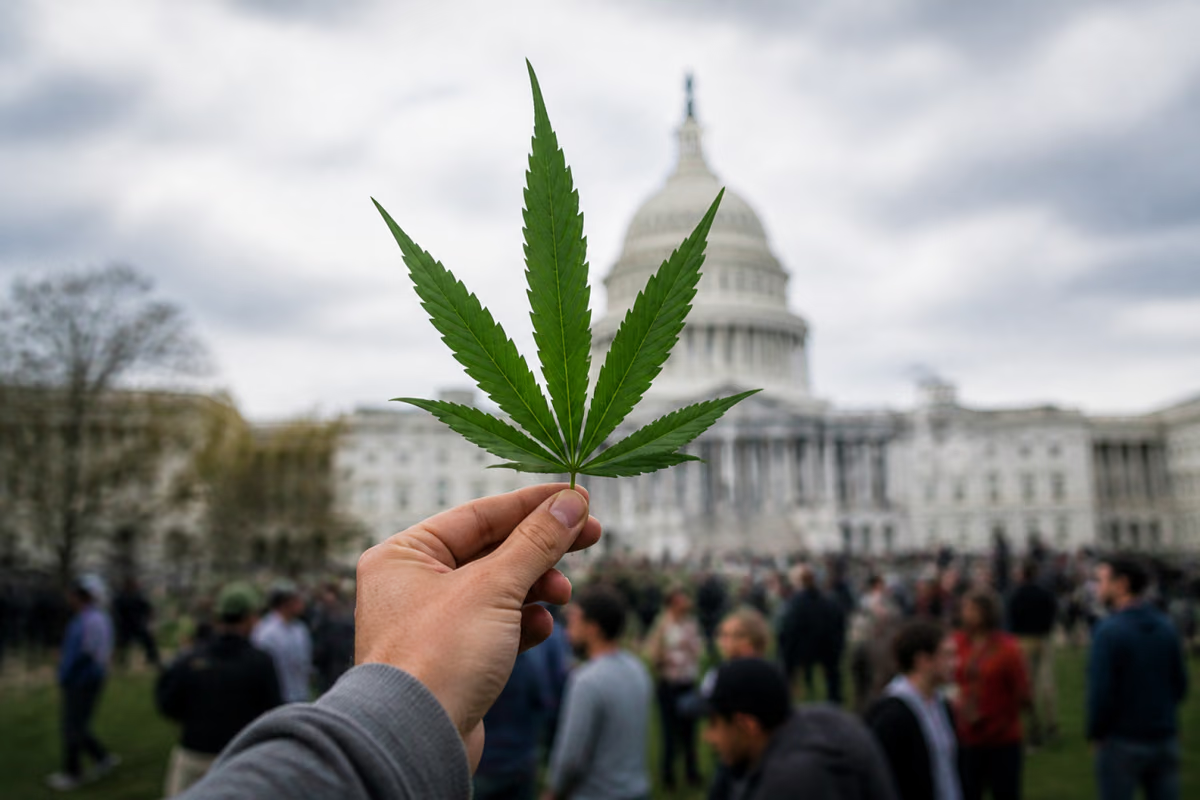
The 2026 US midterms handed Democrats control of both the House and the Senate. That does not mean federal cannabis legalisation is around the corner. The votes needed to pass broad federal reform have barely moved, and the biggest recent federal win, partial rescheduling, came from the Trump administration rather than Congress. The real shift is happening in the states. Pennsylvania, Wisconsin, Iowa and Texas all changed hands in ways that could reshape their cannabis laws within a year or two.
This matters because US policy sets the tone for the global cannabis conversation. It affects banking, research, hemp markets and, ultimately, where growers can legally put a seed in the soil. Here is what actually changed and what didn't.
The New Political Map After the 2026 Midterms
The Democratic sweep went well beyond Capitol Hill. Alongside majorities in both chambers of Congress, the party gained ground across state government:
- Full state control in Pennsylvania and Wisconsin. Democrats now hold a trifecta in both states, meaning one party controls the governorship and both legislative chambers.
- Governor's mansions flipped in Texas, Ohio, Georgia and Iowa.
- State Senate flips in those four states, plus North Carolina, South Carolina, Kansas, Maine and Michigan.
Dozens of new lawmakers will be sworn in this January. They will join the 120th Congress, which is the two-year federal legislative term beginning in 2027, or take seats in statehouses where cannabis bills have been stuck for years.
Historically, a Democratic wave would have been read as a straightforward win for the cannabis industry. 2026 is messier. The most meaningful federal progress this year came through top-down executive action from a Republican administration. Meanwhile, a federal ban on intoxicating hemp products is only weeks away from taking effect. Intoxicating hemp refers to products made from legally defined hemp that still contain enough THC, or THC variants such as delta-8, to produce a high.
So the map has changed. Whether the policy follows depends on where you look.
Why a Democratic Congress Won't Automatically Deliver Federal Reform
Control of Congress creates an opening, but it does not create votes. Anthony Coniglio, CEO of cannabis real estate investment trust NewLake Capital Partners, put it bluntly. Banking reform has had bipartisan support for years, and neither party has managed to get it over the line.
The bill at the centre of that frustration is the SAFE Banking Act. This proposed federal law would protect banks and financial institutions that serve state-legal cannabis businesses from federal penalties. Its track record is a lesson in how legislation stalls:
- The House has passed it seven times.
- The Senate Banking Committee approved it in 2023.
- It has never received a vote on the Senate floor.
"A change in leadership doesn't by itself change that record." (Anthony Coniglio, NewLake Capital Partners)
The problem is structural. Big federal bills need enough Senate support to clear procedural hurdles, and a slim majority rarely provides that on its own. Cannabis also competes with every other priority on a crowded legislative calendar. Party leaders have repeatedly decided it can wait.
For businesses without bank access, waiting means cash-heavy operations, higher security costs and limited access to loans. Coniglio's point is that optimism is cheap. Floor time is the real currency, and the midterms didn't print more of it.
Committee Gavels and the Return of Sherrod Brown
The headline majority matters less than who sits where. According to Coniglio, key committee gavels (the chairmanships that control which bills get hearings and votes) are expected to move to members who have backed cannabis reform. The incoming Senate should also contain more reform supporters than the outgoing class. That improves the odds, but it guarantees nothing.
The most significant name is Ohio Senator Sherrod Brown. He chaired the Senate Banking Committee during the last Democratic majority and was the SAFE Banking Act's most consistent champion. His return puts a proven ally back near the controls of the committee that matters most for cannabis finance.
Adam Rosenberg, Chair of the Board of the National Cannabis Industry Association (NCIA), sees genuine opportunity. He points to an industry generating more than $29bn in annual sales and supporting over 400,000 jobs, still held back by federal rules. NCIA's wish list includes:
- Better access to banking and capital.
- Resolving unfair federal tax treatment. This refers to rules that bar businesses dealing in Schedule I or II substances from deducting ordinary business expenses.
- A durable regulatory framework that respects existing state markets.
In short, the people holding the gavels are friendlier. The path to a floor vote is still narrow.
Trump, Rescheduling and Some Unlikely Allies
President Trump's position on cannabis has been, characteristically, inconsistent. His recent push for rescheduling is widely understood to be the product of concerted lobbying. His promotion of CBD products, including efforts to bring them into certain Medicare schemes, is similarly linked to personal ties with industry figures. CBD (cannabidiol) is a non-intoxicating cannabinoid used in wellness and medical products.
That unpredictability cuts both ways. It has delivered real progress, but it also leaves reform dependent on the mood of one office.
Several incoming and outside voices are already signalling cross-party cooperation:
- Senator-elect James Talarico (D-TX) won one of the night's most significant Senate flips. Asked by Fox News where he could work with Trump, he said: "I agree with the president on the need to legalise marijuana and reform this broken criminal justice system."
- Roger Stone, a long-time Trump ally and GOP operative, told Marijuana Moment he would urge the President to sign cannabis legislation sent to him by Democrats.
For the first time in years, the theoretical pieces line up. A Democratic Congress could send a bill, and a Republican president may be willing to sign it. Whether that theory survives contact with Senate scheduling is another matter.
Where Federal Rescheduling Stands Now
On April 23, 2026, Attorney General Todd Blanche ordered state-licensed medical cannabis moved to Schedule III. Schedule III is the federal drug category for substances with accepted medical use and moderate abuse potential, the same tier as ketamine and anabolic steroids. Cannabis had sat in Schedule I, the most restrictive category, reserved for drugs deemed to have no medical value.
The industry considers this the single most commercially consequential federal reform in a decade. It happened without a single congressional vote.
The big unanswered question is whether adult-use cannabis will follow. Adult-use is the industry term for legal recreational cannabis sold to people 21 and over. Coniglio believes that process runs on its own track:
"State-licensed medical cannabis has already moved to Schedule III, and we remain confident the broader rescheduling proceeding will reach the same result. The timing is uncertain, and that process will continue independently of the election results."
NewLake isn't betting on Washington. The company says it focuses on its properties, its tenants and their cash flow.
Not everyone accepts that reform should depend on administrative processes. Morgan Fox, political director of NORML (the National Organization for the Reform of Marijuana Laws), accused Republican leadership of ignoring public sentiment and letting reform bills languish. He called on Democrats to provide "the necessary leadership and bipartisanship" in the 120th Congress. As Fox put it: "The fate of federal marijuana policy should not be left in the hands of bureaucrats and judges."
Pennsylvania: The Clearest Near-Term Path to Legalisation
If one state is poised to legalise adult-use cannabis next, it's Pennsylvania. Governor Josh Shapiro has championed legalisation and now enjoys a Democratic trifecta after the state Senate flipped. At the time of the latest reporting, Shapiro was predicting a 26-24 Democratic majority in that chamber.
The groundwork already exists. The state House passed a legalisation bill in May 2025, only for it to stall in the then-Republican Senate. The House stays in Democratic hands, and Senate Bill 120, authored by Senator Sharif Street (D), is already sitting in the Senate.
The numbers make a strong case:
- The Pennsylvania Independent Fiscal Office projects nearly US$500m in annual revenue under the governor's plan.
- The state's existing medical market is already worth US$1.8bn a year.
- An April 2026 Susquehanna Polling & Research survey of 705 likely voters found 69% support for regulating and taxing adult-use cannabis, including 67% of Republicans. The survey was commissioned by the Pennsylvania Cannabis Coalition.
That Republican support figure stands out. Legalisation in Pennsylvania is no longer a partisan wedge. It's a majority position across party lines, and the last structural blocker, a hostile state Senate, has just been removed.
Pennsylvania's Industry Demands a Deal
With unified government in place, the debate shifts from whether to legalise to how. The hardest fights are over market structure: who gets licences, how existing medical operators fit in, and how newcomers break through.
Meredith Buettner Schneider, Executive Director of the Pennsylvania Cannabis Coalition (PCC), was clear that the excuses have run out:
"It's well past time for legislative leaders and the governor to come to an agreement on a market structure that creates opportunities for small businesses, provides meaningful pathways for social equity applicants to participate, builds on Pennsylvania's existing cannabis industry, and brings back the jobs and revenue that we're losing to neighbouring states that have already legalised. With unified control of state government, there is no reason to delay legalisation any longer."
Social equity programmes, mentioned in that statement, are licensing schemes designed to give people and communities harmed by past cannabis enforcement a fair chance to own and operate cannabis businesses.
The "neighbouring states" point carries weight. Pennsylvania residents can cross into nearby legal markets, taking tax revenue and jobs with them. Every year of delay is money spent elsewhere. Unified control removes the procedural excuse, though internal disagreements over the details could still slow things down.
Wisconsin and Iowa: A New Legalisation Belt
Wisconsin is one of only a handful of US states that permits neither medical nor recreational cannabis. That could change fast. Governor-elect David Crowley (D) and a newly Democratic legislature are expected to move on legalisation.
- Crowley estimates US$80m to US$170m in annual revenue, earmarked for healthcare.
- Representative Mark Pocan (D-WI) has suggested Wisconsin could legalise as soon as next year.
Going from zero to a regulated market in one jump would be a huge shift for a state long surrounded by more permissive neighbours.
Iowa is lining up on a similar track:
- Senator-elect Josh Turek (D) campaigned on legalising and taxing cannabis sales.
- Governor-elect Rob Sand (D) has proposed legalising, taxing and regulating adult-use cannabis.
Together, these states point to a potential Midwestern "legalisation belt," a cluster of neighbouring states moving toward regulated markets at roughly the same time. Regional momentum matters. When several adjacent states legalise together, cross-border leakage shrinks, supply chains form, and holdout states face mounting pressure.
Texas: The Most Unexpected Reset
Nobody saw Texas coming. Lieutenant Governor Dan Patrick, the architect of the state's crackdown on intoxicating hemp, lost his seat to State Representative Vikki Goodwin (D). She has told Cultivated Daily she would regulate THC like alcohol.
The turnover runs deep:
- Incoming Attorney General Nathan Johnson (D) has previously introduced legislation to decriminalise cannabis and regulate hemp-derived THC. Decriminalisation means removing criminal penalties for possession, usually replacing them with fines, without creating a legal market.
- Governor-elect Gina Hinojosa (D) replaces Governor Greg Abbott.
- Defeated Senate candidate Ken Paxton, who also championed the hemp bans, is out of the picture.
Houston sent its own message. Proposition A makes enforcement of Class A and B marijuana possession misdemeanours the Houston Police Department's lowest priority and bans no-knock warrants. It passed with over 70% approval. Catina Voellinger, Executive Director of Ground Game Texas, which backed the measure, said the result showed Texas's political future was open to change.
A reality check is still needed. The state legislature remains Republican, so comprehensive legalisation is a stretch. The hemp restrictions, however, look far more vulnerable.
Texas Hemp Operators Push Through the Lame-Duck Window
Texas's hemp industry isn't waiting for January. Patrick's crackdown was enforced through regulations issued by the Texas Department of State Health Services (DSHS), and operators want them gone.
David K. Sergi, General Counsel of the American Healthy Alternatives Association (AHAA), has published an open letter to outgoing Governor Greg Abbott. It asks him to direct DSHS to reverse its anti-hemp rules during his lame-duck period, the stretch between losing an election and leaving office when an official still holds full authority. Sergi noted that Abbott had previously vetoed Patrick's hemp bill:
"I realise you lost today, but one good thing you did was to veto Lt Governor Dan Patrick's hemp bill. Ultimately, he is responsible in a great part for your loss, even though you did your part for hemp. Dan Patrick challenged the hemp industry, and it roared louder than any you have ever heard."
The industry is also fighting in court. AHAA has an active lawsuit in Travis County Court against DSHS and Interim Commissioner Imelda Garcia, filed on behalf of eight named Texas hemp operators.
The strategy runs on several tracks at once: political pressure on the outgoing governor, litigation against the regulator, and a friendlier incoming executive branch. Whatever happens with the looming federal hemp ban, the state-level rules may not survive the transition.
Massachusetts Voters Reject Cannabis Repeal by a Landslide
Not every cannabis result was about expansion. In Massachusetts, voters were asked whether to tear down an existing market. Question 8 would have repealed the state's regulated adult-use retail market, which voters approved in 2016 under Question 4 and which has operated since 2018.
The repeal campaign was run by the Coalition for a Healthy Massachusetts. It was largely funded by SAM Action, the political arm of Smart Approaches to Marijuana, a prominent anti-legalisation group. SAM Action spent US$3.7m and won just 24% of the vote. The measure failed by roughly 52 points, a far wider margin than the 53.7% support the original legalisation measure received a decade earlier.
Opposition to Question 8 spanned most of the state's political establishment, including:
- Governor Maura Healey
- Senators Elizabeth Warren and Ed Markey
- Representative Ayanna Pressley
- More than 50 state lawmakers
- The Marijuana Policy Project and the state Cannabis Control Commission
Paul Armentano, Deputy Director of NORML, summed it up: "In fact, more Massachusetts voters support legalisation today than did a decade ago, and these election results prove it."
The lesson travels well beyond New England. Once a regulated market is up and running, voters tend to back it more strongly over time, not less.
What a Decade of Legal Cannabis Built in Massachusetts
The scale of the rejection makes more sense once you see what was at stake. Massachusetts' adult-use market has become a significant part of the state economy:
- Around US$1.5bn in annual sales.
- More than US$10bn in cumulative gross sales, a milestone passed in September 2026.
- Roughly US$336m in cannabis-related tax revenue in fiscal 2026.
- About 15,000 people employed in the sector.
David Bodurtha, Commercial General Manager of RISE Dispensaries Massachusetts, the retail brand owned by Green Thumb Industries, said the vote vindicated ten years of legal operations:
"Massachusetts voters have reaffirmed what 10 years of a functioning legal market have demonstrated: regulated cannabis delivers real benefits for the Commonwealth. Rejecting Question 8 ensures patients and adult-use customers can continue accessing tested products through licensed dispensaries, preserves jobs, supports local businesses, and protects critical tax revenue."
His point about tested products is worth stressing. Regulated markets require lab testing for potency and contaminants, a safeguard the illicit market doesn't offer. For Pennsylvania, Wisconsin and Iowa lawmakers weighing their own bills, Massachusetts now serves as a ten-year proof of concept that voters actively choose to keep.
At a Glance: Key State Outcomes from the 2026 Midterms
Here's a side-by-side look at the states where the 2026 results matter most for cannabis policy.
| State | What changed | Current cannabis status | Near-term outlook |
|---|---|---|---|
| Pennsylvania | Democratic trifecta after Senate flip | Medical only (US$1.8bn market) | Strong: SB 120 pending, ~US$500m projected revenue, 69% voter support |
| Wisconsin | Democratic trifecta; Gov.-elect David Crowley | Neither medical nor recreational | Promising: legalisation possible as soon as next year; US$80m–170m revenue estimate |
| Iowa | Governor and state Senate flipped | Not adult-use legal | Building: Gov.-elect Rob Sand proposes legal, taxed adult-use |
| Texas | Governor, Lt Governor and AG flipped; legislature still Republican | Restrictive; hemp crackdown under DSHS rules | Mixed: hemp rules vulnerable, full legalisation unlikely soon |
| Massachusetts | Question 8 repeal defeated (24% Yes) | Adult-use legal since 2018 (~US$1.5bn/yr) | Secure: market reaffirmed by a ~52-point margin |
The pattern is clear. Federal progress is incremental and largely administrative, while state legislatures are where new markets will actually be born.
What This Means for Growers and the Wider Cannabis Community
We're growers first, so here's our honest take. Don't expect Washington to flip a switch in January. The SAFE Banking Act has passed the House seven times and never reached a Senate floor vote. One election doesn't erase that history. Rescheduling for medical cannabis is done, the adult-use decision is still pending, and the federal intoxicating hemp ban is about to bite regardless of who holds the gavels.
The momentum is in the states, and that's where the next wave of legal cultivation will come from. Pennsylvania has the votes, the polling and a bill on the table. Wisconsin could jump straight from total prohibition to a regulated market. Iowa has a governor-elect who wants to legalise. Texas has, at minimum, a real shot at unwinding its hemp crackdown.
Massachusetts may be the most important signal of all. After ten years, voters didn't just tolerate legal cannabis. They defended it more decisively than they approved it in the first place. Average is our enemy, and so is going backwards.
As always: cultivation laws vary widely by country, state and city. Check your local regulations before you grow, and keep an eye on your statehouse. That's where the 2026 midterms will really be felt.
Frequently asked questions
Will Democrats legalise cannabis federally after the 2026 midterms?
Not automatically. Democrats control both chambers, but broad federal cannabis bills still need enough Senate support to reach and pass a floor vote. The SAFE Banking Act passed the House seven times without a Senate vote. Friendlier committee leadership improves the odds, but industry leaders warn it guarantees nothing.
Has cannabis been moved to Schedule III?
Partially. On April 23, 2026, Attorney General Todd Blanche ordered state-licensed medical cannabis moved to Schedule III, a less restrictive federal drug category. Whether adult-use, or recreational, cannabis will receive the same treatment remains undecided. Industry observers expect that process to continue independently of the election results.
Which US state is most likely to legalise recreational cannabis next?
Pennsylvania looks closest. Democrats now control the governorship and both legislative chambers. A legalisation bill, Senate Bill 120, is already pending, and polling shows 69% voter support, including most Republicans. Officials project nearly US$500m in annual tax revenue from a regulated adult-use market.
What is the SAFE Banking Act?
The SAFE Banking Act is proposed federal legislation that would protect banks and credit unions serving state-legal cannabis businesses from federal penalties. Without it, many operators struggle to open accounts or secure loans and must rely heavily on cash. It has bipartisan support but has never received a full Senate vote.
What happened to Texas hemp regulations after the election?
Their future is uncertain. Lieutenant Governor Dan Patrick, who led the hemp crackdown, lost his seat, and Democrats won the governorship and attorney general's office. Hemp advocates are urging the outgoing governor to reverse state health department rules and are pursuing a lawsuit on behalf of eight Texas hemp operators.
Did Massachusetts repeal legal cannabis in 2026?
No. Voters rejected Question 8, which would have shut down the state's adult-use retail market, with only about 24% voting yes. That market generates roughly US$1.5bn in yearly sales, around US$336m in annual tax revenue and about 15,000 jobs, and it continues to operate normally.
Is Wisconsin going to legalise cannabis?
It looks increasingly likely. Wisconsin currently allows neither medical nor recreational cannabis, but Democrats now control the governorship and legislature. Governor-elect David Crowley estimates US$80m to US$170m in annual revenue for healthcare, and Representative Mark Pocan has suggested legalisation could arrive as early as next year.





 Europe