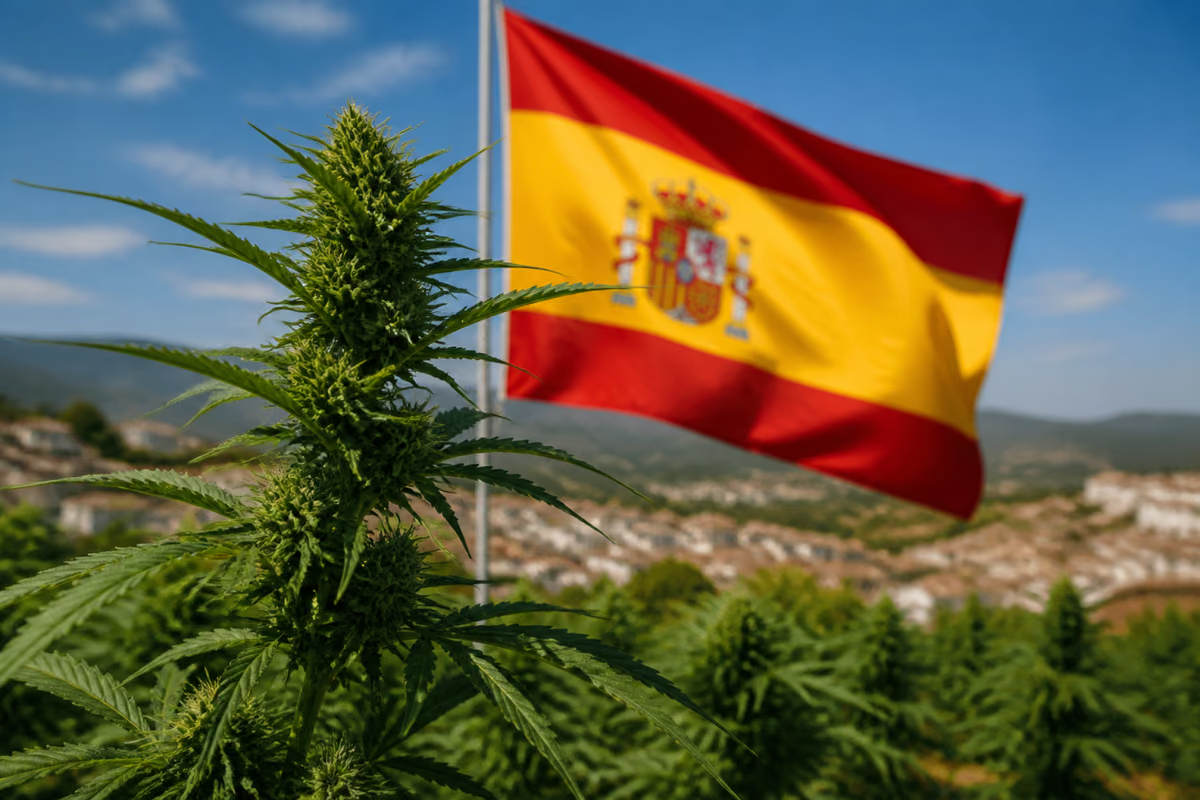
No, weed is not legal in Spain on paper. In practice it sits in a grey area. Private possession and consumption fall outside the Penal Code because of how the courts read it, not because any law decriminalised them. Public possession is a fineable administrative offence. Cannabis social clubs operate in a narrower and more heavily litigated version of the same grey zone. Medical cannabis has been legal only since October 2025, and only as hospital-dispensed oils.
Why does this matter? Spain has a reputation abroad as a cannabis-friendly country. The legal reality is more fragile than that, and several reforms now in motion could reshape it. Here is how the system actually works.
Spain's Cannabis Status: Tolerance by Omission, Not Legalisation
Spain has never passed legislation decriminalising cannabis. No statute, royal decree or parliamentary vote has ever declared private use legal. The space in which Spaniards consume cannabis comes from a gap in the drafting of the Penal Code, and the courts have read that gap consistently for years.
That distinction is important. A tolerated practice rests on interpretation, and interpretation can narrow. A legalised practice rests on written law that only parliament can change. In Spain, judges have treated the gap as narrow and deliberately limited. They have refused to treat it as an invitation to build commercial markets.
The result is a layered system where the legal consequence depends on where and how cannabis is used:
- At home, privately: outside criminal law, as long as there is no trafficking element.
- In public: an administrative offence punished with fines, not prison.
- In social clubs: tolerated under conditions, though the Supreme Court has convicted organisers who went too far.
- For sale or distribution: criminal, whether the product is labelled cannabis or CBD.
- For medical use: legal since October 2025, restricted to standardised oils dispensed in hospitals.
There is no legal recreational retail market of any kind. You cannot walk into a shop and legally buy THC-rich cannabis flower anywhere in the country.
How Article 368 of the Penal Code Creates the Private-Use Gap
Article 368 is the provision of Spain's Penal Code that criminalises drug offences. It covers cultivating, manufacturing or trafficking drugs, and it also covers promoting, favouring or facilitating their illegal consumption. The key detail is that the offence requires an element of distribution or promotion. Possessing or using a substance is not, on its own, what the article punishes.
Private, personal possession and consumption with no trafficking element therefore falls outside what Article 368 covers. Spanish courts have treated this as a narrow gap. Personal use is not a crime. Supplying others still is.
Judges extended the same reasoning to small groups through a doctrine called consumo compartido, or "shared consumption". This is the judicial principle that closed-group cannabis use among adults is not trafficking, provided certain conditions are met:
- The participants are adults who already know each other.
- Nothing changes hands for profit.
- Consumption happens out of public view.
- The group is closed, with no recruitment of outsiders.
Shared consumption is the foundation that much of Spain's club culture was later built on. It was designed for groups of friends, though, not organisations with thousands of members. Every attempt to stretch it further has met judicial resistance.
Public Possession and the Ley Mordaza Fines
Using cannabis in the street, carrying it openly or consuming it in a park is a different matter. Spain's Organic Law 4/2015 on Protection of Public Safety is widely known as the Ley Mordaza ("gag law"). It classifies public possession and use as an administrative offence, meaning a breach punished by fines from the authorities rather than by criminal prosecution in the courts.
Being an administrative offence does not make it cheap. Fines range from €601 to €30,000, and they are issued at scale. CONFAC, the confederation of Spanish cannabis clubs, recorded €130 million in such sanctions in 2023 alone. That figure excludes Catalonia and Navarra, so the true national total is higher.
A reform is on the table. A pending Congressional bill would downgrade public possession to a minor infraction and cut the minimum fine to €100. It has not passed, so the €601 floor still applies today.
The practical takeaway is simple. The private-use tolerance does not travel with you. Once cannabis is visible in a public space, the legal protection disappears and the fine becomes a real possibility.
Cannabis Social Clubs: Europe's Largest Network on Shaky Ground
A cannabis social club is a private, membership-based association where adult members collectively cultivate and consume cannabis on-site. Spain's clubs have never been explicitly legalised or decriminalised. They are generally tolerated because, as with private use, no specific law addresses them directly.
The network peaked at 800 to 1,000 clubs in the late 2010s, the largest of its kind in Europe. It depends on two legal props:
- The shared consumption doctrine, the judicial principle that closed-group, non-profit use among known adults is not drug trafficking.
- A tobacco-law exemption that lets private smokers' clubs permit on-site smoking, which allows members to consume on the premises.
The first prop has limits. When clubs tried to apply shared consumption to large, semi-commercial operations, Spain's Supreme Court pushed back. In three separate 2015 rulings, the Ebers, Three Monkeys and Pannagh cases, it convicted club organisers. The court held that big membership operations were not genuine private consumption at all.
Clubs that survive tend to stay small, closed and non-commercial, and they keep their membership tightly controlled. That is also why short-term visitors often find it difficult to access a club lawfully. A tourist signing up on the spot hardly fits the profile of an adult who "already knows" the group.
The Tobacco-Law Reform That Threatens Club Survival
The second legal prop behind Spain's cannabis social clubs is now in danger. Clubs have relied for over a decade on an exemption in Law 28/2005, Spain's tobacco control law, which allows private smokers' clubs to permit consumption on their premises.
On July 21, 2026, Spain's Council of Ministers approved a draft overhaul of that law. The draft does two things that matter for clubs:
- It eliminates the private smokers'-club exemption entirely.
- It extends smoke-free rules to "herbal products used for smoking, vaping or inhaling".
The phrase "herbal products" never names cannabis, but it clearly covers it. If the bill passes in its current form, clubs would lose the legal basis for on-site consumption. On-site consumption is the core of what a social club is.
For now, nothing has changed on the ground. The bill had not completed its legislative passage at the time of writing, so clubs continue to operate as before. But a protection that seemed permanent now has an expiry date hanging over it. Spain's club model could face extinction without a single cannabis-specific law ever being passed, simply because a tobacco reform swept it up.
CBD in Spain: Why "Under 0.3% THC" Is No Longer a Safe Harbour
THC (tetrahydrocannabinol) is the main psychoactive compound in cannabis. CBD (cannabidiol) is a non-intoxicating cannabinoid sold in oils, flower and pre-rolls. Many European CBD sellers work on the assumption that products under 0.3% THC are compliant. In Spain, that assumption has just been badly shaken.
Commercial sale and personal possession are not judged by the same rules. In April 2026, the Supreme Court's Second Chamber reinstated a conviction against Rafael Fernández de Noreña of Sensitive CBD. The case involved commercially sold cannabis flower, buds and pre-rolls testing at 0.3% to 0.7% THC. The court ruled that the aggregate THC across an entire shipment, not the dose in any single product, could cross the threshold for a public-health offence under Article 368. The conviction stood even though the products were lab-tested and marketed as CBD-compliant.
The sector reacted quickly:
- Competitors including Albert Mayol of CBD Side and Isidre Carballido Enrich of Cannactiva rallied behind the defence.
- The Spanish Industrial Hemp Association (AECANI) commissioned legal reports on EU-level protections for CBD as an isolated substance.
- At least one Spanish law firm called the court's reasoning "discutable" (debatable). It argued the ruling should not be read as settling the question for all low-THC products.
Until that debate is resolved, selling low-THC cannabis flower commercially in Spain carries live legal risk. A lab certificate alone does not remove that risk.
Medical Cannabis: Hospital-Only Oils Since October 2025
Medical cannabis is legal in Spain, but in a tightly restricted form. Royal Decree 903/2025, a regulation issued by the government without a parliamentary vote, was approved by the Council of Ministers on October 7, 2025. It made Spain one of Europe's newest medical cannabis markets.
The framework is among the most conservative on the continent:
- Product: standardised cannabis oil formulations only. Flower is explicitly excluded.
- Prescribers: specialist physicians only. General practitioners cannot prescribe.
- Dispensing: hospital pharmacies only. There is no retail or community pharmacy route.
- Indications: a handful of conditions, not broad access.
The hospital-only rule is now under legal challenge. Two pharmacy bodies have appealed Article 8 of the decree to the Supreme Court. One is the General Council of Official Colleges of Pharmacists, representing 22,000 community pharmacies. The other is the Andalusian Confederation of Pharmacy Offices. They argue the restriction has no legal or health justification and blocks pharmacies from preparing medicines they are already authorised to compound.
The Supreme Court's Administrative Chamber is still reviewing the case, with no ruling date confirmed. If the pharmacists win, patients could one day collect prescribed cannabis oils from their local pharmacy instead of a hospital.
Production, Imports and Exports: A Grower Nation Selling Abroad
Spain is one of Europe's largest cannabis cultivators, even though its domestic market barely exists. Licensing runs through the AEMPS, the Spanish Agency of Medicines and Medical Devices. EU-GMP, or EU Good Manufacturing Practice, is the pharmaceutical quality standard required for medical production.
In 2025, only four companies held AEMPS cultivation licences. Alongside four geneticists and nine EU-GMP-certified operators, they were authorised to produce a combined 19.6 tonnes. In July 2026, Curaleaf became the first company to register actual preparations under the new medical framework. It registered two oil formulations made at its EU-GMP site in Alicante, under an AEMPS processing licence it has held since 2020.
| Period | Medicinal cannabis imports | Medicinal cannabis exports |
|---|---|---|
| 2024 (full year) | 45,099 kg | 46,141 kg |
| 2025 (full year) | 26,883 kg | 30,589 kg |
| H1 2026 | 25,730 kg | 18,305 kg |
Imports are surging. The first-half 2026 figure alone puts the year on track to comfortably beat 2024's total and nearly double 2025's. Portugal supplied 11,386 kg, about 44% of the total, mostly for processing and sterilisation rather than direct dispensing. Exports are moving the other way, down by roughly a third between 2024 and 2025 and falling further in 2026.
Spain still matters abroad. The UK has imported more cannabis flower from Spain than from any other country every year since 2021, according to data running to early 2025.
Will Spain Legalise Recreational Cannabis?
Not any time soon. The government has closed the door publicly. On June 9, 2026, Secretary of State for Health Javier Padilla appeared before the Senate's Mixed Commission for the Study of Addiction Problems. Responding to PP senator Antonia López, he said recreational legalisation was "not, by any means, in the plans."
Padilla went further. He said legalisation "has never been a debate" within the coalition government and that it "would not even be a competence of this Ministry." In his account, the Health Ministry's remit is limited to medicinal purposes. Recreational policy therefore has no institutional home in the current government.
The direction of travel is mixed:
- Possible loosening: the pending Ley Mordaza reform would cut the minimum public-possession fine to €100. The pharmacists' Supreme Court appeal could open community pharmacy access to medical oils.
- Possible tightening: the tobacco-law overhaul would strip clubs of their on-site consumption exemption. The Sensitive CBD ruling has raised criminal risk for low-THC flower sellers.
None of these changes moves Spain towards a legal recreational market. They are adjustments at the edges of a tolerance-based system that the government shows no intention of replacing.
How Spain Compares With the Rest of Europe
Spain is a European paradox. It has the continent's largest cannabis social club network and a medical cultivation base that remains internationally relevant, even as it shrinks. Yet it sells almost none of what it grows into its own market.
Two design choices explain that disconnect. The medical framework excludes flower, so Spanish-grown flower has no domestic medical outlet. The clubs, meanwhile, have no legal retail status, so they cannot act as a licensed sales channel. The flower goes abroad instead, with the UK as the leading buyer since 2021.
Several features set Spain apart from its neighbours:
- Legal basis: Spain's tolerance comes from judicial interpretation, not legislation.
- Club culture: it is the largest in Europe, but it rests on doctrines that courts and lawmakers keep narrowing.
- Medical access: it arrived late, in October 2025, and is restricted to hospital-dispensed oils.
- Industry role: Spain is a supplier to regulated markets elsewhere rather than a regulated market itself.
For growers, the lesson is the one we repeat to our community constantly. A country's reputation is not its law. Spain's relaxed image hides a system where public use draws four-figure fines, CBD sellers face criminal convictions, and clubs depend on an exemption that may soon disappear. Know the rules where you live, and stay on the right side of them.
Frequently asked questions
Is it legal to smoke weed at home in Spain?
Private consumption at home is not a crime in Spain, but no law makes it legal either. It falls outside Article 368 of the Penal Code because that article requires trafficking or promotion. If there is any sign of selling or supplying others, criminal liability can return quickly.
How much is the fine for carrying cannabis in public in Spain?
Under Organic Law 4/2015, known as the Ley Mordaza, public possession or use carries administrative fines from €601 up to €30,000. A pending reform would lower the minimum to €100 by reclassifying it as a minor infraction. That change had not been approved at the time of writing.
Can tourists join a cannabis social club in Spain?
Lawful access is difficult for short-term visitors. Spanish clubs rely on the shared consumption doctrine, which protects closed groups of adults who already know each other. Walk-in memberships for tourists sit uneasily with that principle, and the Supreme Court has convicted organisers of large, semi-commercial clubs.
Is CBD flower safe to sell in Spain?
Not without legal risk. In April 2026, Spain's Supreme Court upheld a conviction against a CBD seller whose flower tested at 0.3% to 0.7% THC. It reasoned that total THC across a shipment could constitute a public-health offence. Lab certificates did not protect the seller from conviction.
Who can get a medical cannabis prescription in Spain?
Only patients treated by specialist physicians for a limited set of conditions. Royal Decree 903/2025 permits standardised cannabis oils dispensed exclusively through hospital pharmacies. General practitioners cannot prescribe, flower is excluded, and community pharmacies currently have no role, although pharmacists are challenging that restriction before the Supreme Court.
Why does Spain export so much cannabis if it is not legal there?
Spain's licensed medical producers grow far more than its restricted domestic framework can use, because Spanish medical rules exclude flower entirely. Much of that output goes to regulated markets abroad. The UK has imported more cannabis flower from Spain than from any other country every year since 2021.



 Europe